
The 35th Massachusetts Volunteer Regiment’s efforts during the Vicksburg Campaign in the summer of 1863 aided the Union in securing control of the Mississippi River. The Regiment had participated in grueling marches during the capture of Jackson, Mississippi’s capital; they were the first Union troops to enter the city when it fell.

The summer Union victories in Mississippi and at Gettysburg enabled the Union to launch a formidable offensive in East Tennessee in the fall of 1863.
Northern control of Knoxville and Chattanooga would disrupt vital supply and transportation routes throughout much of the South, connecting as far east as Richmond.

In early September, the 35th Massachusetts Regiment and other troops that had been “borrowed” for the Vicksburg Campaign rejoined Gen. Burnside and the Army of the Ohio. Burnside dispatched troops from Kentucky to East Tennessee as part of the Union’s fall offensive. This advance succeeded, and the Union Army captured Knoxville and the surrounding area. Chattanooga also fell to Union troops.
However, Southern forces seized the initiative in Southeast Tennessee after the Union Army’s mid-September defeat at the Battle of Chickamauga on the Georgia-Tennessee border. The Confederates went on the offensive against those recent Union gains.
The 35th Massachusetts, returning from the West, had not immediately joined Burnside in Knoxville. Due to the hardships of the “recent campaigns,” the 35th had fewer than two hundred soldiers fit for duty and camped at Crab Orchard, KY, for three weeks before setting out for Knoxville, a one-hundred-and-fifty-mile march through the Cumberland Gap.
After enduring the Mississippi heat that summer, the troops enjoyed their time in the Cumberland Mountains in the fall of 1863. The Regimental History notes that the troops from Massachusetts amused themselves sitting on the stone in the Cumberland Gap, which marks the borders of Tennessee, Kentucky, and Virginia. The 35th Regiment reached Knoxville on October 19, 1863.

Lenoir Station
Proceeding to Lenoir, twenty miles southwest of Knoxville, in late October, they made camp near a rail station for the East Tennessee and Georgia Railroad, which connected Knoxville and Chattanooga.

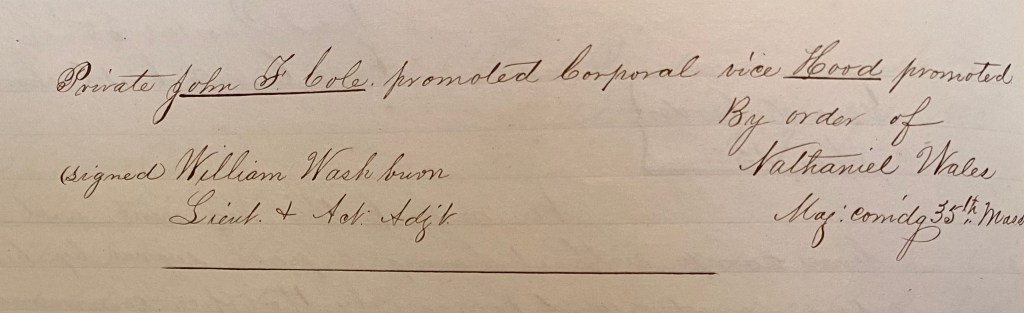
On October 31, at Lenoir, Private John Foster Cole was assigned the duties of an ambulance driver, responsible for transporting wounded soldiers from the battlefield to medical facilities and retrieving the bodies of fallen soldiers.

The next day, on November 1, Cole was promoted to Corporal, taking on increased responsibilities among his fellow soldiers.

The troops faced the prospect of winter quarters. However, one soldier grimly noted that their future “would depend upon the movements of the enemy.” On November 13, Confederate forces, under General James Longstreet, shattered the calm at Lenoir when they began crossing the Tennessee River at Huff’s Ferry, near Loudoun, six miles south of Lenoir. The crossing continued into the next day.

Marching Back and Forth
While outnumbered, late in the day on November 14, Burnside ordered a night march toward Loudon to confront the enemy. The 35th Regimental History vividly describes the miserable conditions of the march: “To say that the road was rough and muddy that night is but a feeble description of it; men stumbled upon each other in the darkness, rapping their file leaders over the head with their muskets, or slipped and sat in the mud, then started on again, guided by the exclamations of comrades rather than by sight, and in the morning found themselves dabbled with mud to the waist.”
However, General Grant countermanded Burnside’s order, believing that falling back to Knoxville was a better strategy for defending that city, the ultimate Union goal.
Consequently, late on the 15th, the 35th’s exhausted soldiers found themselves marching back to Lenoir. As dusk fell and the Brigade approached Lenoir, the 35th was deployed as skirmishers, facing the rear. The Regimental History notes ominously, “the arrangement was looked upon as a sacrifice of the Thirty-Fifth.” When soldiers expressed their fears to their Captain, he grimly responded, “It looks very much like it. Goodbye.” He then rode off, heightening their sense of impending doom.

The Regiment took defensive “positions behind rocks and trees, peering into the darkness.” Instructions were given on “what to do with the flags should the regiment be overpowered.” However, as the Regimental History states, “But a sacrifice was not required.” The 35th then proceeded to Lenoir.
The Race to Campbell’s Station
With Southern troops in close pursuit, Burnside’s forces could not linger at Lenoir. The key to reaching Knoxville was Campbell’s Station, a strategic crossroads about eight miles north of Lenoir.
If Union forces, marching north on Lenoir Road, reached Campbell’s Station first, they could delay the Confederates long enough for their troops and supply train to pass safely and proceed toward Knoxville. However, if Confederate forces, advancing along the parallel Kingston Road, arrived first, they could block Burnside’s path to Knoxville, putting the city at significant risk.
The race to Campbell’s Station was crucial.

In the early morning hours of November 16, Burnside ordered the withdrawal to Knoxville to begin. The 35th Regiment’s Division, the 2nd Division, commanded by Col. Hartranft, would lead the movement north and secure the junction of Lenoir and Kingston Roads. The 35th Regiment’s Brigade, the 2nd Brigade, commanded by Lt. Col. Schall, would also assist First Lt. Samuel Benjamin’s battery personnel in moving artillery pieces, including four twenty-pound Parrott Rifles.

The march was as difficult as one could imagine. The Regimental History paints a vivid picture: “Where the wheels did not sink in the mud, they were blocked by rough rocks; the horses had been overworked for the past twenty-four hours and were now so balky as to be almost useless for hauling… At last, patience became exhausted, ranks were broken, and the men caught hold of the muddy rims of wheels or parts of gun carriages, wherever a hand could seize them, and pushed and shoved to assist the animals.”
The Battle of Campbell’s Station
However, the 35th and other regiments of Col. Hartranft’s Second Division won the race and reached Campbell’s Station at daylight, less than thirty minutes before the Confederates. They advanced two and a half miles south on Kingston Road to confront the Confederate forces. Benjamin’s artillery, a crucial part of Burnside’s strategy, was strategically placed on the ridges around Campbell’s Station.

Despite winning the race to Campbell’s Station, Burnside’s troops faced a continued push from the larger Confederate force. Burnside’s strategy involved holding a defensive position as long as possible, then withdrawing in an orderly manner to a new defensive position under the protection of heavy cannon fire. The twenty-pound Parrott Rifles were especially effective in disrupting Confederate attacks.
The 35th Massachusetts played a crucial role in executing this strategy. At dawn, their Brigade, commanded by Schall, formed a defensive line supported by artillery on Kingston Road below the intersection with Lenoir Road and Campbell’s Station.
The defensive tactic of falling back in an orderly fashion when necessary was employed successfully multiple times on November 16, both above and below the intersection of Lenoir and Kingston Roads south of Campbell’s Station. By noon, the bulk of the Union army and supply wagons had arrived and continued towards Knoxville unimpeded. Further delays of the Confederates served to give the Union troops and supply trains additional time to reach Knoxville.
The final stand at Campbell’s Station began after 4:00 PM, with a new line formed above the intersection to delay the Confederate pursuit. Preventing the Union Army from reaching Knoxville was no longer a possibility for the Confederates. As darkness approached, Burnside ordered the retreat to Knoxville. The 35th’s Regimental History concludes, “The purpose of delaying him for twenty-four hours longer had been attained and our trains secured.
The 35th Regimental History proudly notes its role at Campbell’s Station, “The evolutions upon this battlefield were like the moves upon a chessboard, executed with a precision and regard for military art seldom displayed in active field service in our thickly wooded country.”
The Siege of Knoxville: November 19 – December 4, 1863.
Continuing in darkness, the exhausted soldiers of the 35th began the fifteen-mile march to Knoxville. With Longstreet’s troops pressing their rear, the Regimental History captures the men’s state of mind: “This was, to most of the men, the third night without sleep, so their condition was pitiable. Night marching in close ranks is hard under the most favorable circumstances; these last few hours before reaching Knoxville were spent as in a dream, many declaring that they slept while marching; officers dozed in the saddle; tired human nature could endure no more and insisted upon its right to rest.”
Arriving in Knoxville in the early hours of November 17, the Regimental History states, “the half-starved men received rations of beef and hard bread” and “a rest of a couple of hours.”
The 35th then marched through Knoxville to Fort Sanders, located on a hill northwest of the city, and set to work immediately to improve the fort’s exterior defenses.

The Regiment, assigned to the fort’s northern perimeter, slept for the first time in seventy hours in trenches they had dug that day. They had not slept for three nights.
During the siege of the city, they continued to dig these defensive trenches outside the fort, creating strong defensive positions to man during any attack.

Longstreet’s forces partially encircled the city, and the siege of Knoxville began on November 19, 1863. Despite being outnumbered, Burnside ordered Knoxville to be held “at all hazards and to the last man.” However, the Regimental History adds ominously, “The question of food supply seemed to be the most difficult one to meet; only half or even quarter rations were issued … but the men stood up to their share of the work unflinchingly.”

On November 29, in unusually cold weather, Longstreet launched a pre-dawn assault on Fort Sanders. Confederate troops suffered heavy casualties due primarily to the formidable defenses: 12-foot-deep and eight-foot-wide ditches, as well as various obstacles constructed by Union troops and Knoxville citizens. One particularly effective obstacle was telegraph wire, which was strung between tree stumps at ankle height. In the dim light of the early morning attack, this wire dramatically slowed the Confederate advance, providing Union troops more time to locate and fire upon their targets..

“Longstreet’s Assault on Ft. Sanders.” (Harper’s Pictorial History of the Great Rebellion.)
The attack lasted less than thirty minutes. It was a complete failure for the Confederates. A brief truce was called, and ambulances carried away the dead and wounded. Perhaps Corporal John Cole saw duty this morning.
While the siege recommenced, the defeat at Ft. Sanders effectively ended Longstreet’s hopes of capturing Knoxville. On December 4, 1863, Longstreet abandoned the siege and withdrew his forces to the northeast. General Grant had successfully defended Chattanooga days before.

Praising the troops who manned the defenses he designed at Knoxville, Gen. Orlando Poe declared, ‘The conduct of the men who stood in the trenches at Knoxville cannot be overpraised. Half-starved, with clothing tattered and torn, they endured without a murmur every form of hardship and exposure that falls to the lot of the soldier.

Pursuit and Deprivation in East Tennessee
While the Union had successfully defended Knoxville, Longstreet’s forces continued to challenge Union control of East Tennessee. The Union Army, including the 35th Regiment, left Knoxville to actively pursue Longstreet and to secure control of the region for several months after the battle.
The 35th faced freezing temperatures and frequent rain that winter. Due to inadequate supply lines, they continued to struggle with food and clothing shortages. Their service in East Tennessee after Knoxville may have been just as challenging, if not more so, than the difficulties of the fall campaign.
The Regimental History records on December 8, “Rations were scanty; each man drew one-half ration of pork, one-quarter ration of flour, and to eke out the need [to eat] picked up corn left by the horses and ate it raw or parched.”
One month later, the Regimental History continues, “[N]ecessity, the mother of invention, suggested that moccasins would be better than bare feet upon the snow. According, squares of green hide were issued in couples, and the same old mother was to teach each man how to make into footwear.”
Longstreet’s corps withdrew from East Tennessee in mid-April 1864 to join Robert E. Lee’s Army of Northern Virginia in the Eastern Theater of the war.
Only when the 35th was returning to Kentucky did they receive full rations, their first since leaving Crab Orchard six months earlier. The Regimental History memorializes this moment: “If to remember Mississippi makes one thirsty, one needs but recall Tennessee to feel hungry as well.”
Conclusion: The 35th Massachusetts Regiment in East Tennessee
While Vicksburg is often considered more crucial to the Union’s Civil War victory, and the Massachusetts 35th Regiment was rightly proud of its sacrifice in that campaign, the harsh conditions and logistical difficulties it faced in East Tennessee, especially during the winter campaign of 1863-1864, likely tested its resilience as much as, if not more than, its experiences at Vicksburg.
Often enduring severe hardships, including freezing temperatures, frequent rain, and acute shortages of food and clothing, the soldiers of the 35th demonstrated remarkable strength and determination in East Tennessee.
The contributions of individual soldiers, such as Corporal John Foster Cole, were crucial to this success. As an ambulance driver, Cole navigated the same treacherous, muddy roads as the artillery caissons, often he and his horses were called upon to pull cannons through the mire. Beyond these logistical challenges, he faced the grim battlefield realities of aiding the wounded and removing the dead during the ceasefire that followed the Confederate assault on Ft. Sanders.
The Regimental History notes the signs displayed in Pittsburgh as the 35th soon returned to the East: ” Welcome to our Country’s Defenders! ” The Union maintained control of East Tennessee for the remainder of the war.
Acknowledgments
Thanks to Paul Harrison of the Reference Division at the National Archives in Washington for his assistance with records of the 35th Regiment. A similar note of gratitude goes to Susan Greendyke Lachevre, Curator, Massachusetts State House, who provided access to the historic images of the 35th Regimental flags. Because of their assistance, this post is hopefully more than just another dry military history.
Sources: 35th Regiment.
Massachusetts in the Civil War (1889) (Summary by regiment.)
35th Personnel Summary – Enlisted, Killed,Wounded, Missing
Additional Sources
Augustus, Gerald L. The Battle of Campbell’s Station: November 16, 1863. Cherohala Press, Cleveland, TN, 2013.
Brearley, William H. Recollections of the East Tennessee Campaign: Battle of Campbell Station and Siege of Knoxville. Detroit: Tribune Book and Job Office, 1871. 17th Michigan Volunteers.
Cogswell, Leander W. Eleventh New Hampshire Regiment. Concord, 1891. 11th New Hampshire Regiment.
Gambone, A.M. Major-General John Frederick Hartranft. Butternut and Blue, Baltimore, 1995. Major-General Hartranft.
Parker, Thomas H. History of the 51st Regiment of Pennsylvania. King & Baird, Philadelphia, 1869. History of 51st Regiment of Pennsylvania
Stovell, Caryl L. The Union Army and the Knoxville Region of East Tennessee, 1861 – 1865. (1951). Stovell – Union Army and Knoxville, 1861 – 1865.
Temple, Oliver P. East Tennessee and the Civil War. The R. Clarke Co., Cincinnati, 1899. Oliver – East Tennessee and Civil War
Woodbury, Augustus. Major General Ambrose E. Burnside and the Ninth Army Corps. Sidney Rider & Brother, Providence, 1867. Major Gen. Ambrose Burnside & the Ninth Army Corps.
One response to “The Cole Brothers’ Civil War Journey (6): John Foster Cole in the Mountains of Tennessee.”
Thank you brother for bringing our family history to life for all of us. The courage and fortitude that all those brave men faced under unimaginable conditions leaves me in awe!