

AFTER ANTIETAM
Survivors of The Battle of Antietam had endured the bloodiest battle of the Civil War. Neither side sought to resume hostilities the next day. Gen. McClellan ordered the Army of the Potomac “to do nothing likely to renew the action.” Gen. Lee’s Army of Northern Virginia began its retreat across the Potomac, starting down the Shenandoah Valley towards the Confederate capital city of Richmond.
While relieved the battle was over, the soldiers of the 35th Regiment held differing opinions about their army’s efforts the previous day. Some felt that the Union Army had missed an opportunity to isolate Lee and end the war. Others thought they were victorious in forcing Lee and his army to retreat.
However, the 35th knew their regiment’s orders had been to take the lower bridge and, when the Union Army’s advance towards Sharpsburg failed, to hold that hard-won bridge. General McClellan had told Major General Burnside, ” Hold the bridge at all hazards; if that is lost, all is lost.” The 35th defended the bridge at a considerable cost.

The decision not to pursue Lee gave the 35th time to assess its losses in battle; the casualties totaled over two hundred. Sixty-nine “heroes laid down their lives for that terrible day’s work.” Less than three hundred men were available for duty on September 18th. The 35th lost many of its officers, including the wounding of the regiment’s commanding officer, Col. Carruth.
On September 19, 1862, the regiment formed and marched through the fields where they had fought two days before. They marched on the very land they had fought so valiantly to gain and then to defend. The enemy had fled. The fields were now abandoned, strewn with debris, dead horses, and makeshift graves.
The 35th camped a few miles south of Sharpsburg, where the Antietam Creek flowed into the Potomac. The 35th spent most of October marching and drilling. They were learning to become soldiers after they had been in battle rather than before.

On October 27, 1862, the 35th Massachusetts Volunteer Regiment, now with 400 men ready for duty, was one of the first Union regiments to cross the Potomac at Brunswick, MD, east of Harper’s Ferry. The army slowly moved southwest along the east side of the Blue Ridge Mountains, concerned with the possibility of Lee’s forces attacking from the west.
Fredericksburg
McClellan’s slow pace caused Lincoln to act on his long-standing frustration and replace him with Gen. Burnside in early November. Burnside soon developed a plan to beat Lee to Richmond by swiftly moving the Army southeast from its position near Warrenton. Key to the plan was capturing Fredericksburg on the Rappahannock River thirty-five miles away. Speed was essential. He left Warrenton on November 15th.
In two days, Burnside reached Falmouth, on the Rappahannock opposite Fredericksburg, with less than 500 Confederate forces guarding the city. Burnside’s plan was working, perhaps too well.

Fredericksburg’s bridges crossing the 400-foot wide river had been destroyed earlier in the war, and the Union Army’s pontoons, which they had used to cross the Potomac after Antietam, had yet to arrive. Burnside delayed the assault on Fredericksburg.
Lee used this much-needed time to complete his forces’ movement to Fredericksburg and to establish defensive positions, especially at Marye’s Heights, which overlooked the city from the west. When the pontoons arrived, Confederate fire from the city prevented the bridge’s construction. A frustrated Burnside ordered Fredericksburg shelled from across the river on December 11th.
After the city was severely damaged, Union troops again attempted to finish the bridge. However, Southern troops returned to the city and again prevented the completion of the pontoon bridge. Union troops, crossing the Rappahannock by boat, were finally able to drive out the Confederate forces from the bombed-out city. Work then resumed on the pontoon bridges.

The 35th Regiment of Gen. Ferrero’s 2nd Brigade finally crossed the Rappahannock on the morning of December 12. Some troops amused themselves in the now empty southern city; others noted the continued Confederate positions above the city beyond a half-mile-wide plain.
Early the next afternoon, the 35th was called to move on those Confederate positions when Regiment Commander Major Sidney Willard called, “Attention!” The Regimental History records, “The men fell in with compressed lips – the time had come.”

The Major then gave the order, “Forward – Thirty-Fifth! On centre – dress! Remember Antietam!”
Major Willard was mortally wounded shortly after issuing the command to move forward.
The 35th moved east from the city’s edge and, after crossing the railroad tracks, swung south and recrossed the tracks. From behind a low ridge in the open plain west of Hazel Run, they faced the Confederate right flank about two hundred and fifty yards away, secure behind an almost impregnable stone wall on the top of Marye’s Hill.
The regiment fought from this position and did not attempt to advance on Marye’s Hill, “not having been ordered to do so.” Without Major Willard to order them forward, it appears no one gave that command.
The 35th fought until it had exhausted its ammunition. It then fell back and was soon replaced by another regiment, but remained on the field, lying low and watching the damage being done behind them by bullets flying over their heads.
Many in the Union Army had questioned the wisdom of the assault on Fredericksburg after Lee had time to establish defenses. While the 35th is credited with having fought “with unflinching firmness,” the “Final Attack” of Antietam was too fresh on the minds of the 35th to advance without an explicit command to do so.
The 35th’s losses totaled ten killed and about sixty wounded. The loss of Major Willard was especially devastating to the regiment.
Union losses were higher for those troops fighting closer to the center of Marye’s Heights. A Confederate cannoneer is quoted as boasting, “A chicken could not live on that field when we open on it.”
The 35th returned to Fredericksburg at dark and camped on the river bank. The next day, like Antietam, neither side “took the initiative.” The 35th recrossed the Rappahannock and returned to Falmouth quietly at midnight on December 15th.
The Union’s defeat was overwhelming. The Union losses were double (12,500) those of the Confederacy (6,000). One Confederate soldier said Fredericksburg was “the simplest and easiest won battle of the war.” It has also been called “the most wasteful slaughter of the war.”
CAMP LIFE AFTER FREDERICKSBURG
The 35th regiment remained near Falmouth until early February 1863. Conditions there were described simply as “miserable.” The Regimental History notes the combined effect of the cold, raw weather and the defeat endured at Fredericksburg, “Turn which way one would, it was cold comfort everywhere for body or mind, and all tended to dejection. The wind swept across the open fields and searched out our very marrow.”
The History insightfully adds, “The best relief was work. …. Those who lay about the cooks’ fires listlessly, or coiled up in blankets in their little tents, soon found the way to the surgeon’s tent, the hospital and often, to their graves.”
As suggested, the battlefield was not the only place soldiers feared for their lives. More Union soldiers died of disease of all types during the Civil War than on the battlefield. Simply put, a soldier was more likely to die from a disease than from enemy fire.
Civil War battles were intense, deadly, and brief. In contrast, Civil War camp life was crowded, often dull, and prolonged. Camp life also frequently exposed soldiers to contaminated drinking water and primitive sanitation conditions. Camp life provided ideal breeding grounds for many infectious diseases. Chief among them were dysentery and typhoid fever, commonly known then as “camp fever.”

During the Civil War, there was no effective treatment for these diseases. A surgeon at Falmouth said, “Very little can be done for a man while he lies upon the ground with typhoid fever…When I order one to hospital, it seems almost equivalent to ordering his grave dug.”
The “first death by disease” in the 35th regiment occurred at Falmouth on January 14th, 1863, four months after the regiment was left Boston. The death of 18-year-old Private Everett A. Jernagan was due to “Acute Dysentery.” The second death, 34-year-old Private Shepard G. Wiggin from typhoid fever, occurred two days later. Wiggin left behind a wife and four young children.
These deaths would not be the last. At least six others died of disease either at Falmouth or in Washington hospitals where they had been transferred.

CAMP AT NEWPORT NEWS &
CHARLES WARREN COLE
After the “Mud March,” Gen. Burnside’s ill-fated attempt to cross the Potomac again in January 1863, he was removed as commander of the Army of the Potomac. However, Lincoln soon reappointed Burnside as the Ninth Army Corps commander and, as a result, he was reunited with the 35th regiment.
On February 9th, the 35th regiment, having broken camp at Falmouth, steamed from nearby Acquia Creek down the Potomac to the Chesapeake Bay and Newport News, VA. At Newport News, the regiment made camp on the plain between the river and the swamp in “extremely close quarters.”

Despite warmer weather at Newport News, deaths due to disease increased; the Regimental History explicitly states, “[T]he location proved unhealthy, owing to the stirring of the malarious swamp in the rear when cutting the wood for camp purposes.”
The Regimantal History then continues, ironically, “The embalming agents visited camp, and set up their machinery; but we preferred to be excused [from] their well-intentioned manipulations.”
Four members of the 35th died of what is today commonly known as typhoid fever at Newport News. Among them was nineteen-year-old Charles Warren Cole.
While we do not know the details regarding the onset and duration of his illness, Charles Warren Cole succumbed to “Camp Fever” on March 3, 1863, at Newport News.
The Cole Brothers had been away from Boxford for less than eight months, and their regiment had been through three deadly and historic battles when Charles Warren died.
We can only presume that John Foster was able to comfort his younger brother during the days or possibly weeks of his painful and increasingly debilitating condition and that they were together when Charles Warren passed away. Perhaps John Foster also had the opportunity to write home to Boxford, informing his parents of his brother’s illness before writing again later, delivering the sad news.
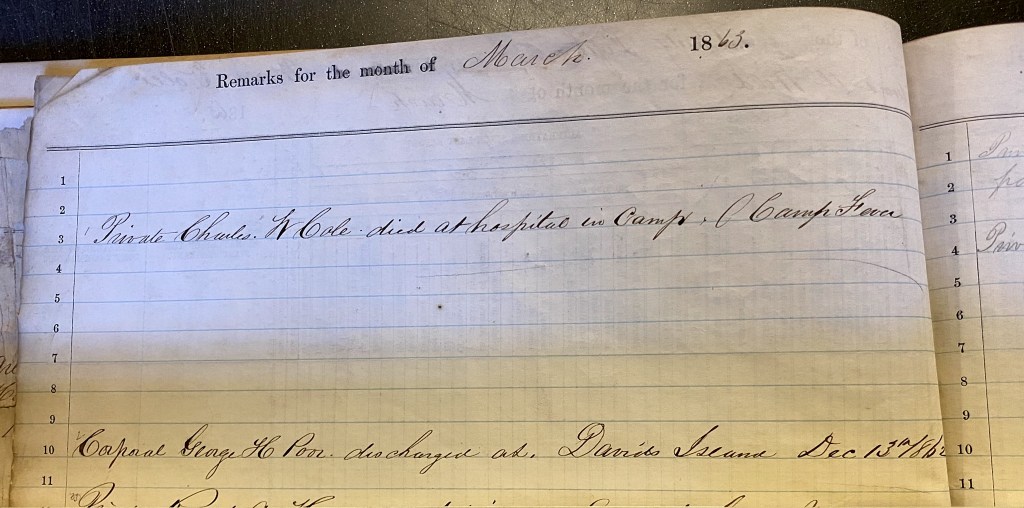
The Regimental History records the scene at Newport News: “Thus this ground, like most of the spots upon which the regiment staid any length of time, was marked by the graves of some of our number.”
After quoting the entirety of Longfellow’s poem, “A Nameless Grave,” the History notes, “It is permitted us to linger over these memories now, but in those days the stern duties before us demanded quick forgetfulness of the past.”
Charles Warren Cole does not lie in a nameless grave. Instead, his body was returned to his home in Boxford, MA, where he was buried at Mt. Vernon Cemetery, where many members of his family had been and would later be buried.

The 35th Regiment would soon receive word that Gen. Burnside and the Ninth Corps had been assigned to the Department of the Ohio. The 35th would soon be traveling west.
Sources: General
This post has benefitted from the maps, drawings, and early photographs available at the Library of Congress to help tell the story of the 35th Mass Volunteer Regiment in a way that words alone could not accomplish. Especially useful has been Meagan Snow’s blog post, “Mapping the Battle of Fredericksburg.”
In general, the maps and pictures available at the Library of Congress are invaluable and should not be overlooked. Library of Congress: Digital Collections.
Wipperman, Darin. Burnside’s Boys. (2023). Stackpole Books, Essex, CT.
Sources: Specific to the 35th Massachusetts Volunteer Regiment
35th Personnel Summary – Enlisted, Killed,Wounded, Missing
Massachusetts in the Civil War (1889) (Summary by regiment.)
Massachusetts in the Army and Navy during the war of 1861-1865. (Overall source.)