


The McGurn Boys: Jim, John, Ed, Bill and Bob with Father before 1940.
On October 16, 1940, more than 16 million American men between the ages of 21 and 35 registered for the draft. John and Jessie McGurn’s two oldest sons, Jim and John, were among them. Eventually, four of the five McGurn sons would see combat in World War II. The youngest graduated from high school as the war ended; he also served.

October 9, 1943 – Lawrence Eagle Tribune.
James Frances McGurn


Jim had been married to Louise Creeley for five years when he registered. The childless couple lived near her parents on Prospect Hill in Lawrence, where they would live for the rest of their lives. At 5′ 4″ and 125 lbs., Jim was the smallest of the five McGurn sons. He had hazel eyes and brown hair.
Unlike his father, Jim worked in South Lawrence at the Wood Mill, the primary subsidiary of the American Woolen Company.
Jim was drafted into the Army at age 31 on June 4, 1943, and assigned to the 34th Infantry Division, which took part in the Invasion of Italy. Jim may have been with the 34th as it landed at Anzio Beach in January 1944. He was likely an “individual replacement” and joined the 34th during combat operations. Jim certainly was with the Division during the mountainous combat that preceded the capture of Rome in June later that year. To say that the 34th saw heavy fighting is an understatement, and Jim was hospitalized at least twice. The first time was in February 1944 for foot problems stemming from frostbite. Years later, he would tell about standing in foxholes with frigid cold water soaking his boots. The second hospitalization occurred in June when an artillery shell wounded him in the shoulder and foot.
Jim was awarded the Purple Heart for his service to his country.


At some point, Jim was transferred stateside and ultimately stationed at Ft. Devens in Ayer, Mass. His parents requested Congressional support for this transfer. The fact that his younger brother, John, had been killed in action weighed heavily on his family, especially his mother. Corporal James McGurn (Serial # 31360317) was discharged on December 13, 1946.
John William McGurn


John W. McGurn was twenty-five years old when he registered for the draft. At that time, he was single and living with his parents and younger siblings on Union Street. John also worked in the Wood Mill with his older brother, Jim. In his pictures, he always appears taller and more robust than 5′ 7″ and 155 lbs. He doesn’t vary, however, from the usual McGurn description of light complexion, brown hair, and hazel eyes.
John was inducted on Valentine’s Day, 1942, almost two years after registering (Serial # 31065209). He reported to nearby Ft. Devens and was assigned to the Army’s 1st Battalion 180th Infantry, a Regiment of the 45th Infantry Division.
After spending the winter and spring training at several different bases in the United States, the regiment left in late June 1943 for Algeria in North Africa.
The 45th Infantry Division, nicknamed the “Thunderbirds,” was soon to become a key component of the U.S. Seventh Army under General George S. Patton during the Allied invasion of Sicily in July 1943.
As a part of the Invasion of Sicily, the 180th Infantry landed on July 10 in southeast Sicily in the Gulf of Gela. They then moved northeast to Palermo before moving east to Messina, which was taken in late August 1943. Sicily had fallen relatively quickly.
The 180th Infantry, as part of the 45th Infantry, invaded Italy around Salerno in early September. Allied troops, including the 180th Infantry, began their long slog north towards Rome, opposed by the German Army; the Italian Army had surrendered early in the invasion.
Progress was slow, however, due to fierce fighting and rugged terrain. While the Allies were ultimately successful in taking Rome in June 1944, John W. McGurn was killed in action on December 20, 1943, most likely during an offensive on a major German defensive line, the Bernhardt Line, east of Cassino, near Mt. Camino or Mt. Molino. His body was buried in the temporary R. Fratelli Military Cemetery in the Valley below Mt. Cassino.

His parents, Jess and Jack, were both at home when the dreaded Western Union Telegraph messenger knocked on the door of 18 Union Street. Jim’s wife, Louise, who lived there during the war, answered the door. Jack, working in the basement, came to the first floor thinking the voice was one of his sons; John’s prediction to his brother-in-law Chip the year before had come true. Several weeks later, the McGurns received this letter from the Secretary of War.

John’s body was returned home in September 1948 for burial at St. Mary’s Cemetery in Lawrence, Mass. The family could have decided to allow John’s body to remain in a permanent military cemetery in Italy. Jessie was the only one who supported “bringing him home.” She won, of course.


Edward Joseph McGurn.


Ed, age 20, was living at home and working at the Pacific Mills when he registered for the draft on June 30, 1942. He is the only McGurn son to list his father as “the person who will always know your address.” Ed was the first McGurn to graduate from high school. He did so, of course, from Central Catholic in Lawrence.
He is about the average McGurn height, weight, and coloring. Ed entered the Navy in Boston on September 1, 1942. The address on the draft card changed to Inman St. in South Lawrence during the war, reflecting his 1944 marriage to Doris Dupont.
While Ed’s card shows that the McGurns’ telephone number was “Lawrence 31063,” John had stated on his 1940 registration that the McGurns didn’t have a telephone. At some point during those two years, Jess and Jack acquired a phone; they would take the number with them when they moved across the street to 29 Union. They would have that number for more than 30 years. It would become a “party line” with the Brain’s “31902.”
Ed served in the South Pacific as a Ship’s Cook 1st Class on several ships. He was on the USS Lindsey, a destroyer minelayer, in July 1945 when it stopped at Pearl Harbor. Also at Pearl Harbor was his brother Bill’s battleship, the USS Bunker Hill, showing significant damage due to a Japanese aerial attack. Distressingly for Ed, he could not visit the Bunker Hill to determine his brother’s fate before the Lindsey had to be underway. He only later learned via a letter from home that his brother was safe. Ed (Serial # 6079926) served until December 1945.


Wartime wedding of Ed & Doris.
Doris and Ed were married while Ed was on leave in August 1944. As shown here, the wedding guests included Chip and Helen Brain with children Gerry and John, sister-in-law Louise, younger brother Bob, and parents Jess and Jack.
William Patrick McGurn

Bill registered for the draft on February 8, 1943, which he thought was his 18th birthday. (His father had failed to record his correct birthdate of February 6 with the Town Clerk.) Bill was still in high school. It is somewhat puzzling that Methuen High School on Pleasant St is listed on his card.
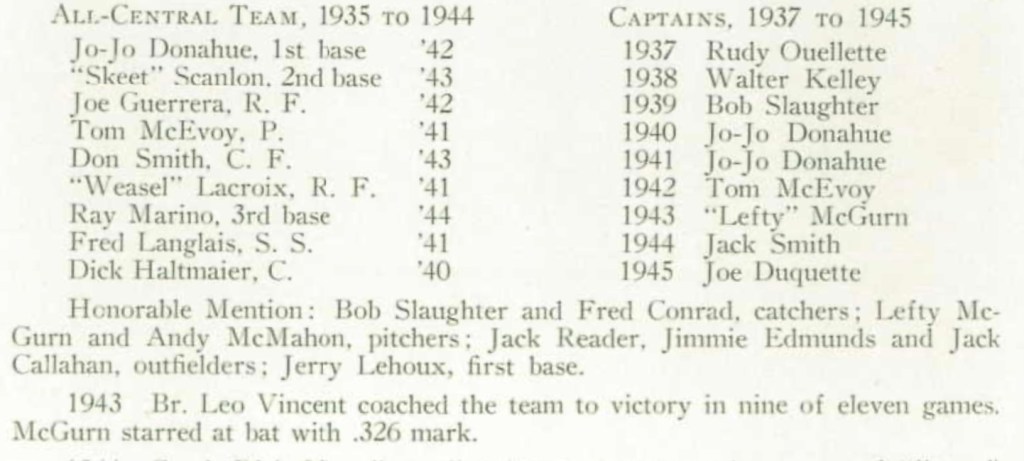
“Lefty” McGurn was Lawrence’s Central Catholic High School 1943 baseball team captain. He also hit .326 that year and earned an “honorable mention” as a pitcher for the “All-Central Team” for the first ten years of the school’s existence. He was also captain of the basketball team.
At 5’9″, Bill was the tallest McGurn. I’m surprised that he’s not listed as 5’11”, but at 155 pounds, I wonder what Jessie was feeding him? Bill was a standout high school athlete, however.
Brown eyes and hair both seem like the McGurn way.


Less than a month after his high school graduation, Bill reported for Navy Basic Training on June 28, 1943 (Serial # 8022506). Before Labor Day, he was a Seaman Second Class on a new Essex class aircraft carrier, the USS Bunker Hill. This was the only ship upon which Bill would see duty.
In September 1943, the Bunker Hill sailed from Norfolk, VA, through the Panama Canal to Pearl Harbor and headed to the Southwest Pacific. They first saw action two months later. In April 1944, Bill was promoted to Sailor First Class.
During the invasion of Okinawa in May 1945, Bill’s ship was struck by two Japanese kamikaze planes, leaving 372 sailors either killed or missing and 264 wounded. Bill, who was off duty then, was forced to abandon the ship. After some time in the water, he was rescued.


USS Bunker Hill – May 11, 1945.
The Bunker Hill was badly damaged but was able to return to the west coast via Pearl Harbor for repairs. These repairs hadn’t been completed when the Japanese surrenderd in September1945.
Bill would maintain for the rest of his life that, “The war in the Pacific was won by battleships.” None of his family who heard this assertion and knew what he had experienced ever disputed his claim. In fact, naval historians do not doubt the significant role played by Essex-class carriers in the Pacific during World War II.
Robert John McGurn
Robert John McGurn, the youngest of the McGurn boys, was born December 29, 1927, and was 14 years old when the war started. (He wrote his brothers often but wouldn’t show his letters to his parents.
His high school yearbook showed he badly wanted to follow his brothers’ footsteps into the armed forces. But, then again, the prediction made by almost all of the Class of ’45 was that they would be in the service within a year of graduation.
When the war ended on September 2, 1945, he was a 17-year-old recent graduate from Central Catholic High School in Lawrence.


When Bob finally could sign up for the Navy at age 18, the military would be “downsizing” both in terms of people and equipment. The Navy would face the challenge of dealing with the thousands of ships of all types built to win the war. That’s the Navy in which Bob enlisted.


Bob’s two-year enlistment in the US Navy began on March 25, 1946, as a Seaman 2nd Class (Serial # 7517850). He was promoted to 1st Class within four months. He was first assigned to the LST 907, a landing ship used to support amphibious operations, and subsequently to the LSM(R) 516, a heavier-duty landing ship. These two ships were later decommissioned. Bob’s last assignment was in Norfolk, VA in 1947.
Bob’s “draft card” was filled out on September 11, 1948 when his time on active duty was over. He had been serving in the Navy reserves since his discharge. He was living with his parents at 29 Union St. and would be married to Mary Paquette the following year.
It may be impossible to appreciate World War II’s effect on the lives of those who called 18 Union Street home. However, the emotional toll it took on Jessie McGurn, the matriarch of the family, can only be imagined and can’t be overstated.
Just focus on the family picture above, from Ed and Doris’s wedding in the middle of the war. Absent from the wedding are three McGurn sons. John had been killed just months earlier. Jim was in Italy in the later phases of an operation in which John had been killed, and Bill was somewhere in the Pacific, soon to be the target of two kamikaze bombers.
The eight-year period from May 1940, before the war even began, when her only daughter moved to Hartford, CT with her new husband to work at Pratt & Whitney Aircraft, to September 1948, when her son, John, was finally returned home for burial, had to be harrowing to the point of being almost unbearable for Jessie. It is no wonder that we visited John’s grave often and, each year, were still attending a memorial mass on the Saturday before December 20, as late as 1960.
The effects may be more subtle for the rest of us, but I suspect they continue to exist.
The 45th Infantry Division


After John’s death in December 1943, the 180th fought at Anzio Beach and helped capture Rome. They then landed in southern France and helped drive into Germany, where they were when the war ended in September 1945.
His father received the above membership card in 1948.
Detailed military histories relating to John P. McGurn’s service, which may be of interest, are available online at the following sites:
180th Infantry: A Regiment of the 45 Infantry Division
The 45th Military History in WWII
Fifth Army at the Winter Line: 15 Nov 1943 – 15 Jan 1944